
A 1,950 TH/s Bill: Where 4% and 2% Actually Land
Two percentages appear on a ViaBTC fee schedule because two different piles of coin are being charged. At 1,950 TH/s the gross credit is $74.09 a day at $84,692, and the listed 4% on the block-reward component comes to $2.96 of that, while the listed 2% on the PPLNS-distributed components would be $1.48. Neither rate applies to the other's coins, and that is the whole idea.

Key takeaways
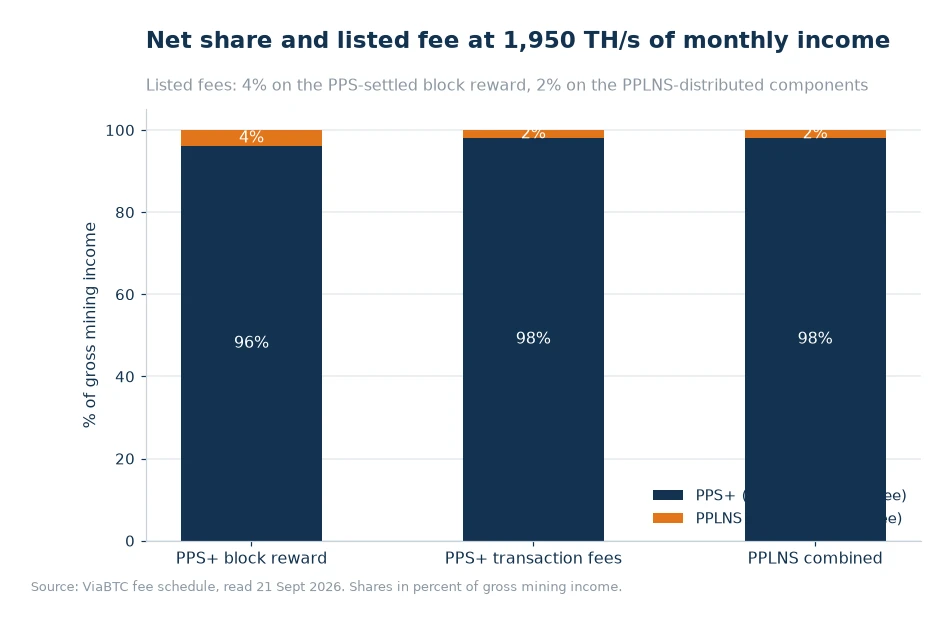
- PPS+ splits a payout: the listed 4% sits on the PPS-settled block reward and the listed 2% on the fee component.
- PPLNS charges the listed 2% on both components combined, settled after 6 confirmations.
- At 1,950 TH/s, gross is $74.09 a day, so the block-reward rate is worth $2.96 and the fee rate $1.48.
- Mining payouts carry no withdrawal fee, so the schedule is the only deduction on the way out.
Two rates because there are two piles
A block pays a subsidy plus whatever transaction fees the block collected. Under PPS+, those two piles are treated differently. The subsidy is settled per share at a fixed rate against current difficulty, which puts the risk of an unlucky pool onto the operator. The transaction-fee pile is distributed the PPLNS way, sharing the miner's slice over a window of recent rounds.
The rates follow the risk. The pile that is paid regardless of whether the pool finds a block carries the listed 4%. The pile that depends on which blocks were found carries the listed 2%. Reading the schedule as one blended number hides exactly the distinction it was written to express, and it makes the two payout modes look more similar than they are.
The split at 1,950 TH/s
The table treats each component as if the whole day's gross belonged to it, which gives the size of each listed rate on the same $74.09. In practice the subsidy is the larger part, so the 4% line is the closer estimate of the total deduction.
| Component | Listed rate | Share kept | Fee on a $74.09 day |
|---|---|---|---|
| PPS+ block reward | 4% | 96% | $2.96 |
| PPS+ transaction fees | 2% | 98% | $1.48 |
| PPLNS combined | 2% | 98% | $1.48 |
| Mining payout withdrawal | 0% | 100% | $0.00 |
The last row is the one people forget to check. A schedule can look cheap on the mining side and expensive at the exit, and the reverse is also possible. Here the withdrawal of mined coins carries no fee, so the four rows above are the complete set of deductions on the way from share to wallet.
Worked example
Take 1,950 TH/s and follow the numbers from the network total to the fee.
- Network output: 3.125 BTC × 144 blocks = 450 BTC a day.
- BTC per TH/s: 450 ÷ 1,003,107,267 = 0.00000044861.
- 1,950 TH/s: 1,950 × 0.00000044861 = 0.00087479 BTC a day.
- Value: 0.00087479 × 84,692 = $74.09.
- Listed 4% on the block-reward component: 74.09 × 0.04 = $2.96.
- Listed 2% on the PPLNS-distributed components: 74.09 × 0.02 = $1.48.
- Thirty days at the same rate: 74.09 × 30 = $2,222.70 gross, of which $88.91 and $44.45 respectively.
What the gap is worth over a month
Two percentage points on a $2,222.70 month is $44.45, which is not nothing and not a reason to choose a payout mode on its own. The larger question is variance. PPS+ hands the pool the luck and charges for it; PPLNS leaves the luck with the miner and charges less. Over a long run the two should converge around the same expectation, but a month is not a long run.
For an operation at 1,950 TH/s, a single month of PPLNS can land above or below the PPS+ equivalent by more than the fee difference. That is the trade being offered, and it is a preference about cash-flow shape as much as a calculation. An operator with a fixed power bill may prefer the steady series; one who can absorb a thin month may prefer the lower rate. A quarter is a better sample than a month, and a year is better than a quarter.
How the fee is actually taken
Fees are deducted at settlement, not invoiced later. Under PPS+, the hourly credit already reflects the listed 4% on the block-reward part, so the number that lands in the account is net. There is no separate payment to make and no balance to top up, which is why the credit history is the right place to check what was charged.
That design matters for accounting. If you reconcile a month, compare the gross arithmetic at your hashrate with the sum of credits rather than subtracting a fee from a statement. The difference should match the schedule to within rounding, and a persistent mismatch means the hashrate or the date range in your calculation is wrong.
One detail makes the credit series look uneven even when nothing is wrong: the transaction-fee portion under PPS+ follows PPLNS timing, so it arrives after a block is confirmed rather than in the same hour as the subsidy. A day with no block in the window will show the subsidy credit alone. That is the schedule working as described, not a missing payment.
Checking the schedule against your own numbers
The ViaBTC Pool Fees page states both rates and names the component each one applies to. Read it with your own hashrate in hand, then confirm the result against a day of credits. The Profit Calculator does the same arithmetic from coin price, difficulty, rate and effective hashrate, and it includes merged-mining output for coins that use it.
For an operation that sizes its power contract around a loan, the Collateral-Pledged Loans product follows a documented sequence: Add Collateral, Apply for Loan, Receive Loan, Repay Loan, Redeem Collateral. Fee arithmetic and borrowing arithmetic are separate, and mixing them in one spreadsheet is how a workable plan starts to look like a clever one.
Fees are the small line
On a $74.09 day, $2.96 is the largest listed deduction. Power at 20 J/TH for 1,950 TH/s is 39 kW, or 936 kWh a day, which at $0.06 per kWh is $56.16. The fee is real money, but the electricity is roughly nineteen times larger, and it is the line that decides whether the operation continues.
That ratio is worth keeping in view when fee schedules are compared across pools. A percentage point is a rounding error next to a tariff difference of one cent per kilowatt-hour at this efficiency. The fee is worth understanding precisely because it is small and predictable; the power contract is worth negotiating because it is neither.
Frequently asked questions
Is the PPS+ fee 4% or 2%?
Both apply, to different components: the listed 4% is on the PPS-settled block reward and the listed 2% on the transaction-fee part that is distributed under PPLNS logic.
What does PPLNS charge?
The listed 2% on the block reward and transaction fees combined, with settlement after 6 confirmations across the last 5 difficulty rounds.
How much is that at 1,950 TH/s?
Gross income of $74.09 a day gives a listed 4% of $2.96 on the block-reward component and a listed 2% of $1.48 on the PPLNS-distributed parts.
Write the rate next to the component
A fee schedule is only confusing when the components are left out. Put "4%" beside "block reward" and "2%" beside "transaction fees, or both under PPLNS" on one line each, then multiply by a day of gross income at your hashrate. At 1,950 TH/s that is $2.96 and $1.48, and both figures are small enough to check by hand in under a minute.
Do that once, keep the result near the power calculation, and the payout mode becomes a decision about variance rather than a guess about percentages.
Sources: the ViaBTC pricing, calculator and loan pages for listed rates and product steps[1]. Inputs read 21 Sept 2026: 1,003 EH/s, 132.76 T, 3.125 BTC per block, 144 blocks a day, BTC $84,692. Published 22 Oct 2026; figures assume constant difficulty and continuous uptime.