
OEM and ODM in One Programme: An A/B Comparison for Subscription Brands
OEM and ODM are usually presented as a choice, but a subscription fragrance line often needs both at once: a developed signature scent for the hero product, and library-led variants that keep the range moving without a new development budget every quarter. The practical question is not which model is better, but which decisions each route owns, because that is what determines who signs off, who holds the documentation and how long a change takes. The comparison below puts the two side by side on the points where they actually diverge.
Key takeaways
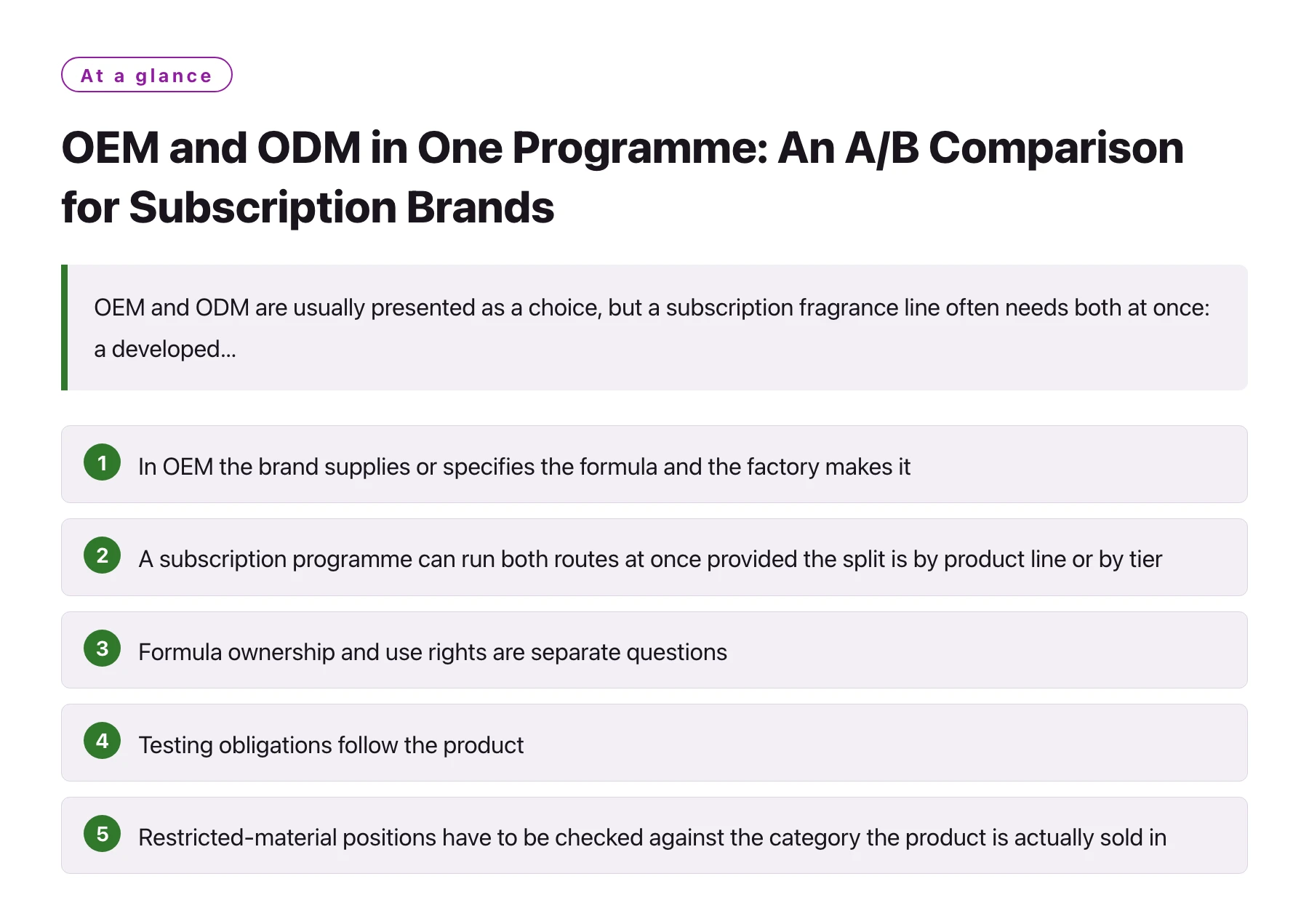
- In OEM the brand supplies or specifies the formula and the factory makes it; in ODM the factory develops the scent and the brand selects, which moves the development risk and some of the intellectual property to the supplier [1].
- A subscription programme can run both routes at once provided the split is by product line or by tier, never by batch, because mixing models inside a single stock keeping unit is where ownership disputes begin.
- Formula ownership and use rights are separate questions, and a development fee paid under an ODM arrangement does not by itself transfer ownership of the composition.
- Testing obligations follow the product, not the model: whichever route is chosen, the finished pack still needs compatibility and stability evidence for the target market [2].
- Restricted-material positions have to be checked against the category the product is actually sold in, and that check sits with whoever holds the formula [3].
- The route that looks cheaper at the first order is often the more expensive one by the third, because development-led work carries a setup cost that only amortises across repeats.
Subscription selling rewards a stable hero scent and punishes stagnation. A brand needs one signature composition that customers resubscribe to, plus enough variation to make the second and third shipments feel worth opening. Those two needs pull in opposite directions: the hero scent argues for ownership and control, while the variants argue for speed and someone else's development budget.
That is why a combined programme has become common. The brand develops or commissions a signature, then fills the surrounding range with compositions the manufacturer already holds and can produce quickly. The arrangement works well, but only when the boundaries are written down, because the two routes differ in who owns what, who approves what and who is responsible when a limit or a regulation changes [4].
The comparison below is organised around decisions rather than around labels. Read it as a way to allocate responsibility, not as a verdict on either model.
A/B comparison at the decision points that matter
| Decision point | Route A: brand-led OEM | Route B: development-led ODM | What a subscription brand should watch |
|---|---|---|---|
| Who creates the scent | The brand's brief, and often the brand's perfumer, defines the composition | The manufacturer develops candidates from a brief and presents a selection | Who approves the final version, and how many revision rounds are included |
| Who owns the formula | Usually the brand, with the factory granted production rights | Often the manufacturer, with the brand granted use rights in a defined field [1] | Whether the rights survive a change of supplier or a change of owner |
| Time to first sample | Longer, because development sits outside the factory | Shorter, because candidate compositions may already exist | Whether speed is worth a narrower set of options |
| Cost shape | Development cost carried by the brand, production cost comparatively clean | Development folded into the production price, with a setup element that repeats | Which lines fall away on a reorder and which do not |
| Testing responsibility | The brand commissions and interprets, with the factory supplying data | The manufacturer usually organises testing as part of development [2] | Whether the evidence is transferable if the brand later moves production |
| Restricted-material review | The brand holds the formula and the review record | The manufacturer holds both and reports the position [3] | What the brand receives in writing, and how it is updated |
| Exclusivity | Easier to grant, because the composition is already the brand's | Needs a defined field, territory and duration, or the scent may appear elsewhere | Whether the restriction covers the categories the brand actually sells in |
The pattern in the right-hand column is consistent: whichever route is chosen, the subscription brand's risk sits in what it holds in writing. A combined programme that runs Xuelei fragrance production across both routes is workable, but only if the brand can answer the ownership, testing and exclusivity questions product line by product line.
How to split a range between the two routes
The cleanest split is by tier. The signature composition that customers resubscribe to belongs on the brand-led route, where the formula, the reference sample and the test evidence are all held by the brand. The seasonal or flanker products that keep the programme interesting belong on the development-led route, where speed and a lower incremental cost matter more than long-term control.
A second workable split is by format. A home fragrance or body product in the same scent family can follow the factory's existing composition while the fine fragrance stays brand-led, which keeps the range coherent without duplicating development work.
What should never be split
Never split a single product across both routes. If one batch of the same stock keeping unit is compounded from a brand-owned formula and another from a factory composition, the two will diverge in ways that are difficult to document and impossible to explain to a customer who notices a change. The split belongs at the product line, not inside it.
It is also worth keeping one route responsible for the compliance file of each product. A combined programme that handles this well is one where a full ODM fragrance service can be used for a flanker without disturbing the paper trail that supports the hero scent.
The clause that keeps a combined programme stable
Put a short boundary schedule in the agreement: for each product line, the development route, the formula holder, the rights granted, the testing owner and the exclusivity field. One page is usually enough, and it removes the ambiguity that otherwise surfaces two years later when a brand wants to move a product to a different manufacturer or launch in a new market.
Where the combined programme is intended to run as a single relationship rather than as separate projects, it helps to describe it that way from the start, and it is the scope statement rather than the model name that is worth reading closely.
A quick diagnostic for a proposed combined programme: ask the supplier to name, for each product line, who holds the formula, who holds the test reports and who can sell the same scent to another customer. If the answers are consistent and specific, the split is understood. If the supplier hesitates on the third question in particular, the exclusivity position is probably less defined than the proposal implies. If the programme is meant to run as one relationship rather than as a set of separate projects, the scope statement is where that intention either appears or does not, which is the reasoning behind what one-stop scent development covers.
Sources
- WIPO — World Intellectual Property Organization —— The UN agency for intellectual property; resources on industrial design and patent protection relevant to product and packaging design.
- SGS: Cosmetics, Personal Care & Household Testing —— Testing, inspection and certification services for cosmetics and personal care, including microbiological, stability and safety testing aligned with cosmetics GMP.
- IFRA Standards Library (International Fragrance Association) —— The IFRA Standards Library lists the restrictions the fragrance industry applies to individual fragrance ingredients, based on safety assessments; it is the reference point for compliant fragrance formulation.
- Cosmetics Europe —— The European trade association for the cosmetics and personal care industry, publishing guidance, positions and market information.
Frequently asked questions
Can a brand use OEM for one product and ODM for another with the same factory?
Yes, and it is common. The arrangement works when the boundary is drawn at the product line and each line has a named formula holder, testing owner and exclusivity field. Problems arise when the same stock keeping unit draws on both routes, because consistency and documentation become difficult to guarantee.
Does ODM mean the brand does not own the scent?
Not necessarily, but ownership is not implied by the label. Many ODM arrangements keep the composition with the manufacturer and grant the brand use rights in a defined field and territory. What matters is the written position, not the model name.
Which route suits a subscription brand's first product?
If the scent is the reason customers resubscribe, brand-led development is usually worth the extra time and cost, because it keeps the asset and the evidence with the brand. A development-led route makes more sense for the second and third products, where speed and cost matter more than long-term control.
How is testing handled when both models run in one programme?
Per product, not per model. Each finished pack needs compatibility and stability evidence for its market, and the agreement should say who commissions it, who pays for repeats, and what the brand receives if it later moves production elsewhere.
What happens to exclusivity in a combined programme?
Exclusivity has to be defined for each composition separately: the field, the territory, the duration and whether other customers can buy the same scent. A combined programme without that schedule leaves the brand guessing about a question that only becomes urgent once the product succeeds.
Allocate capital with intent.
PFN Dai fuses transformer-based on-chain analytics with proprietary DeFi signal models — engineered for funds that don't guess yield.
Request a Platform DemoView Audited Performance